Introduction
Traveling with a battery‑powered spin scrubber can streamline cleaning tasks in hotels, rentals, and vacation homes, yet many travelers remain uncertain about airline policies and packing techniques. This guide explains the regulatory landscape, offers practical packing methods, and compares leading scrubbers so readers can choose the device that best fits their itineraries. By the end of the article, readers will understand how to transport their cleaning tools safely, comply with TSA rules, and maximize the value of their investment.
Background and Context
Battery‑powered spin scrubbers combine a high‑speed motor, interchangeable brush heads, and a rechargeable lithium‑ion battery to automate the removal of soap scum, grime, and stains. Modern models typically operate between 350 RPM and 480 RPM, provide up to 100 minutes of runtime, and feature IPX7 waterproof ratings for use in damp environments. Understanding these technical specifications is essential because airline regulations often differentiate between devices that contain lithium batteries and those that do not.
Most spin scrubbers fall into the category of “personal electronic devices” under TSA guidance. The key considerations are battery capacity (measured in watt‑hours), whether the battery is removable, and how the device is packed. Devices with batteries under 100 Wh are generally allowed in carry‑on baggage, while larger batteries may require special handling or be prohibited entirely. The scrubbers highlighted in this guide all use batteries well below the 100 Wh threshold, making them eligible for most commercial flights.
Airline Regulations and TSA Guidelines
Before boarding, travelers should verify the specific airline’s policy, but the following universal rules apply in the United States:
- All lithium‑ion batteries must be installed in the device; spare batteries must be carried in carry‑on luggage only.
- The battery’s watt‑hour rating must not exceed 100 Wh. None of the featured scrubbers exceed this limit.
- Devices must be turned off and protected from accidental activation. Many scrubbers include a safety lock or require a two‑step power‑on process.
- If a battery is damaged, swollen, or shows signs of leakage, it must be declared and may be prohibited.
During security screening, TSA officers may ask travelers to remove the scrubber from its case for X‑ray inspection. Keeping the device in a clear, zip‑top bag simplifies this process and reduces the likelihood of delays.
Packing Strategies for Spin Scrubbers
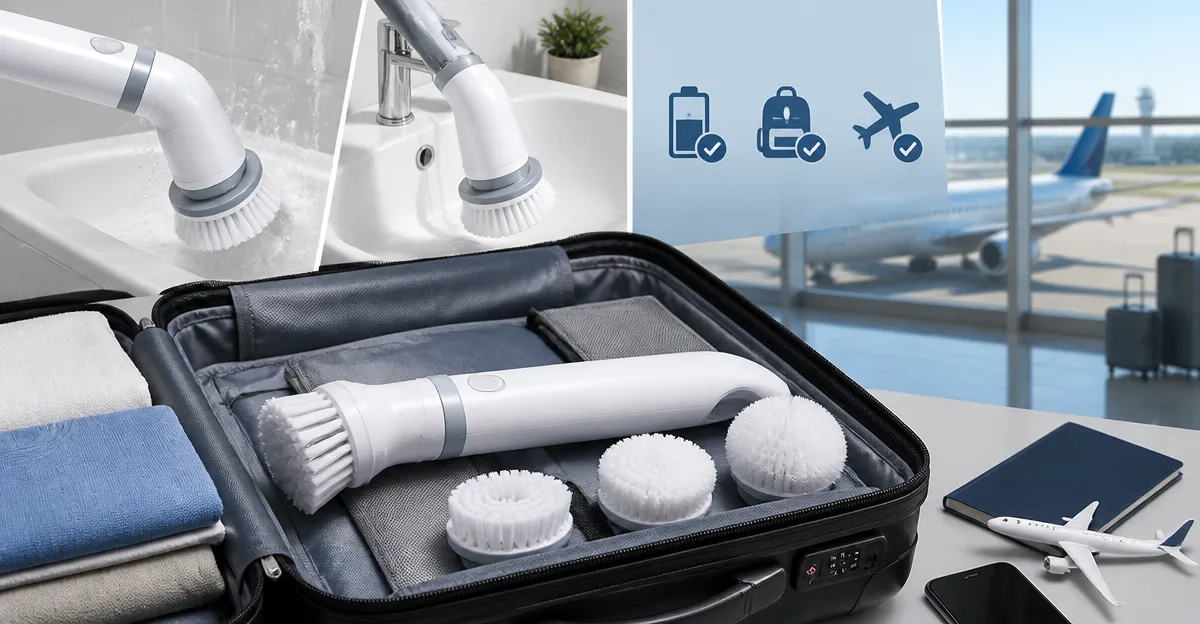
Effective packing protects the scrubber, preserves battery life, and complies with airline rules. Consider the following steps:
- Use a dedicated travel case. A hard‑shell or padded case prevents impact damage, especially for models with extendable handles.
- Remove detachable brush heads. Store heads in a separate zip‑top bag to avoid loss and to keep the main unit compact.
- Charge the battery to 50‑70 %. This level balances safety and ensures sufficient power for cleaning upon arrival.
- Place the scrubber in carry‑on luggage. Because the batteries are under 100 Wh, they are permitted in the cabin, which reduces the risk of temperature extremes in the cargo hold.
- Label the battery. A small sticker indicating the watt‑hour rating can expedite TSA verification.
When selecting a scrubber for travel, size, handle adjustability, and battery runtime become decisive factors. The following products exemplify a range of options:
For a compact yet powerful option, consider the YKYI Cordless Spin Scrubber. Its stainless‑steel handle adjusts from 12 inches to 43.3 inches, providing flexibility for both tight hotel bathrooms and larger vacation rentals. The 2600 mAh battery delivers up to 100 minutes of runtime, which comfortably exceeds a typical two‑day trip cleaning schedule.
The WKY Cordless Spin Scrubber offers the highest torque at 42 in‑lbs, making it ideal for travelers who anticipate heavy grime, such as beach house sand or kitchen grease. Its 10‑in‑1 brush set and telescopic pole reduce the need for additional tools.
If space is at a premium, the TUYU Cordless Spin Scrubber provides a lightweight design with a retractable handle ranging from 26 inches to 45 inches. The inclusion of a mesh storage bag simplifies organization in a carry‑on suitcase.
For travelers who prefer a non‑battery‑dependent solution, the Rubbermaid Reveal Power Scrubber Kit uses replaceable AA batteries, allowing easy replacement if a flight limits battery‑powered devices. Its oscillating head operates at 60 strokes per second, delivering rapid cleaning for grout and tile.
The budget‑friendly Dreazu Cordless Spin Scrubber balances performance and price. With a 2500 mAh battery, it offers 60‑90 minutes of runtime and an adjustable handle up to 48 inches, suitable for taller users.
Comparison and Selection Guide
| Feature | YKYI Cordless Spin Scrubber | WKY Cordless Spin Scrubber | TUYU Cordless Spin Scrubber | Rubbermaid Reveal Kit | Dreazu Cordless Spin Scrubber |
|---|---|---|---|---|---|
| Price (USD) | 33.99 | 23.74 | 33.99 | 25.99 | 24.69 |
| Battery Capacity | 2600 mAh (100 min) | Not disclosed (high torque) | 2500 mAh (90 min) | AA batteries (replaceable) | 2500 mAh (60‑90 min) |
| RPM | 380 / 480 | 350 / 450 | 350 / 450 | Oscillating 60 Hz | 350 / 450 |
| Torque | Standard | 42 in‑lbs (ultra‑high) | Standard | Not applicable | 44 in‑lbs |
| Brush Heads | 8 interchangeable | 10‑in‑1 (7 heads) | 4 replaceable | 8 heads + pads | 7 interchangeable |
| Handle Extension | 12‑43.3 in | Telescopic (unspecified) | 26‑45 in | Fixed handle | 41‑48 in |
| Waterproof Rating | IPX7 | IPX7 | IPX7 | Water‑resistant | IPX7 |
| Average Rating | 4.5/5 (515 reviews) | 4.5/5 (256 reviews) | 4.4/5 (8,804 reviews) | 4.4/5 (38,691 reviews) | 4.3/5 (2,352 reviews) |
Travelers should prioritize the following criteria when selecting a scrubber for trips:
- Battery life vs. travel duration. Longer runtime reduces the need for recharging during layovers.
- Handle length. Adjustable poles prevent bending and are crucial for high‑ceiling hotel bathrooms.
- Brush variety. Multiple heads enable cleaning of tile, glass, grout, and even car rims during road trips.
- Weight and packaging. Lightweight models with integrated storage bags fit more easily into carry‑on luggage.
Best Practices & Tips
Beyond regulatory compliance, travelers can adopt habits that extend battery health and improve cleaning efficiency:
- Pre‑charge before departure. A fully charged unit ensures immediate use upon arrival.
- Carry a universal Type‑C charger. All featured scrubbers except the Rubbermaid kit use Type‑C ports, simplifying charging on the road.
- Use the low‑speed setting for delicate surfaces. Glass shower doors and polished tiles benefit from reduced RPM to avoid scratches.
- Combine cleaning solutions with the motor. Applying a mild detergent before activation maximizes grime dissolution.
- Store the device in a moisture‑proof pouch. Even with IPX7 ratings, prolonged exposure to humidity can affect the battery contacts.
When staying in accommodations with limited power outlets, consider a portable power bank that supports 5 V/3 A output for Type‑C charging. Verify that the power bank’s capacity does not exceed airline limits for spare batteries (generally 100 Wh).
Frequently Asked Questions
Can I bring a spin scrubber in checked luggage?
Yes, but the battery must be removed or the device must be turned off and protected from accidental activation. Most airlines prefer lithium batteries in carry‑on to reduce fire risk.
Do I need to declare the scrubber at security?
If the scrubber is in your carry‑on, you do not need a separate declaration unless the battery is damaged. Present the device for X‑ray inspection if asked.
What is the maximum watt‑hour rating allowed in the cabin?
U.S. regulations permit up to 100 Wh per battery. All scrubbers listed have batteries well below this threshold.
Can I use the scrubber on a plane’s seat or tray?
It is advisable to avoid using any cleaning device on aircraft interiors to prevent damage and to comply with airline policies.
How do I prevent the battery from draining during a long layover?
Turn the unit off completely, remove any attached brush heads, and store it in a insulated pouch. If possible, keep it in a carry‑on where temperature is controlled.
Are there any size restrictions for the scrubber’s handle?
Airlines do not limit handle length, but a compact, telescopic pole is easier to fit in overhead bins.
Conclusion
Traveling with a battery‑powered spin scrubber offers a convenient solution for maintaining cleanliness in temporary living spaces, provided that passengers respect airline regulations and employ smart packing strategies. By understanding battery limits, selecting a model that balances torque, runtime, and portability, and following the best‑practice tips outlined above, travelers can enjoy a spotless environment without compromising safety or convenience.
Products Featured in This Guide
YKYI Cordless Spin Scrubber
Price: $33.99 | Rating: 4.5/5 (515 reviews)
Featured for its adjustable 12‑43.3 in stainless‑steel handle, 2600 mAh battery offering up to 100 minutes of runtime, and eight interchangeable brush heads suitable for diverse travel cleaning scenarios.
WKY Cordless Spin Scrubber
Price: $23.74 | Rating: 4.5/5 (256 reviews)
Featured for its ultra‑high 42 in‑lbs torque motor, 10‑in‑1 brush set, and telescopic pole that reduces strain during extended cleaning tasks.
Rubbermaid Reveal Power Scrubber Kit
Price: $25.99 | Rating: 4.4/5 (38,691 reviews)
Featured for its oscillating head that delivers 60 strokes per second, water‑resistant construction, and the ability to operate with replaceable AA batteries—ideal for travelers facing airline battery restrictions.
TUYU Cordless Spin Scrubber
Price: $33.99 | Rating: 4.4/5 (8,804 reviews)
Featured for its lightweight design, retractable handle (26‑45 in), and included mesh storage bag, making it exceptionally travel‑friendly.
Dreazu Cordless Spin Scrubber
Price: $24.69 | Rating: 4.3/5 (2,352 reviews)
Featured for its 44 in‑lbs high‑torque motor, 2500 mAh battery providing 60‑90 minutes of runtime, and an adjustable handle up to 48 in, offering a cost‑effective solution for frequent travelers.