How Do Electric Spin Scrubbers Work? A How‑To Guide to Their Mechanism, Use & Maintenance
Introduction
This guide explains the mechanical principles behind electric spin scrubbers, demonstrates how to use them effectively, and provides maintenance strategies that extend product life. Readers will understand motor speed control, battery management, and brush‑head selection, enabling them to achieve professional‑grade cleaning results in residential environments. The information is valuable because it reduces physical strain, shortens cleaning time, and protects surfaces from damage.
By following the step‑by‑step instructions, homeowners can transform a tedious chore into a quick, ergonomic task. The guide also highlights five highly rated models that exemplify the technology discussed, allowing readers to make informed purchasing decisions.
What You'll Need
- Charged electric spin scrubber (see product recommendations below)
- All‑purpose bathroom cleaning solution
- Microfiber cleaning cloths
- Protective gloves (optional for sensitive skin)
- Small container for water rinse
Step‑by‑Step Instructions
1. Prepare the Cleaning Area
Begin by removing loose debris such as hair, soap scum, and personal items from the surface to be cleaned. Sweep the floor of the shower or bathtub to prevent the brush from catching on objects. Apply a thin layer of cleaning solution to the target area; this reduces friction and enhances the scrubber's efficiency.
Using a product with a reliable motor and waterproof rating ensures safe operation in wet environments. The TUYU Electric Spin Scrubber offers an IPX7 waterproof rating, a 90‑minute runtime, and a digital battery display. At $33.99 and a 4.4‑star rating from 8,374 reviews, it provides a cost‑effective solution for this preparation step.
Its lightweight design prevents fatigue while the extendable handle reaches high tiles without the need for ladders. The user can therefore focus on surface preparation rather than struggling with equipment.
2. Charge the Device Fully
Before any intensive cleaning session, ensure the scrubber is fully charged. Connect the Type‑C charging cable to a power source and monitor the LED indicator until it turns green. A full charge typically requires three to four hours for the TUYU model and provides up to 90 minutes of continuous operation.
For users who prefer a longer battery life, the PUFTEM Electric Spin Scrubber delivers up to 180 minutes on a single charge thanks to its larger battery capacity. Priced at $24.99 with a 4.3‑star rating from 3,520 reviews, it includes a battery level display that prevents unexpected shutdowns.
Fully charging the device reduces interruptions, allowing the user to maintain a steady cleaning rhythm and avoid repeated recharging cycles that can shorten overall battery lifespan.
3. Select the Appropriate Brush Head
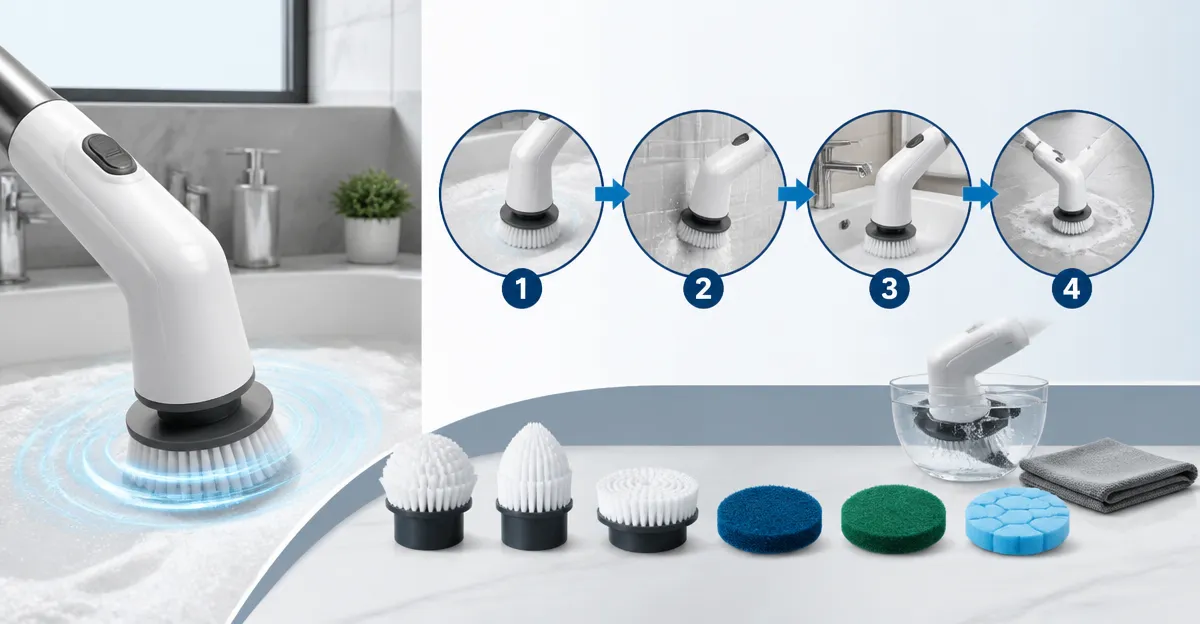
The brush head determines the contact surface and cleaning intensity. Soft‑bristle heads are ideal for glazed tiles and glass, while tougher nylon heads excel on grout and textured surfaces. Most modern scrubbers provide interchangeable heads that attach with a simple click mechanism.
The Bomves Electric Spin Scrubber includes seven replaceable heads, covering flat, corner, and polishing applications. At $39.99 and a 4.3‑star rating from 13,316 reviews, it offers versatility for multiple cleaning scenarios within a single package.
Selecting the correct head prevents surface scratching and maximises cleaning efficiency. The user should detach the current head, align the new head’s locking tabs, and click until a secure fit is felt.
4. Adjust the Extension Handle
Proper handle length eliminates the need to bend, thereby protecting the lower back and knees. Most scrubbers feature a telescopic stainless‑steel rod that extends between 26 and 53 inches depending on the model.
The CTMAST Electric Spin Scrubber provides an adjustable pole ranging from 12 to 53 inches, allowing users to reach ceiling‑high shower walls without a ladder. Priced at $23.99 with a 4.2‑star rating from 3,446 reviews, it balances reach and stability.
To adjust, rotate the handle clockwise, pull the rod outward to the desired length, and lock it by twisting in the opposite direction. Ensure the lock is firm before activating the motor.
5. Choose the Desired Speed Setting
Modern scrubbers feature dual‑speed motors, typically offering a low speed for delicate surfaces and a high speed for stubborn grime. Low speed generally operates around 350‑300 RPM, while high speed reaches 450‑500 RPM.
The TUYU model provides two speeds—350 RPM low and 450 RPM high—selected by a single press of the power button. This simplicity reduces user error and allows quick adaptation to varying cleaning demands.
For users who require a broader range, the PUFTEM scrubber offers 350 RPM for normal cleaning and 400 RPM for deep cleaning, with a one‑click speed toggle. The higher torque of the Dreazu model (44 in‑lb) also maintains consistent rotation under pressure, making it suitable for heavily soiled areas.
6. Operate the Scrubber on the Surface
Place the brush head against the surface and activate the motor by pressing the power button. Move the scrubber in slow, overlapping strokes to allow the rotating bristles to lift dirt without excessive force. For grout lines, use the corner brush and apply gentle pressure.
When cleaning glass shower doors, switch to the soft‑bristle head and use the low‑speed setting to avoid scratches. The LED battery display on the TUYU and PUFTEM models informs the user of remaining power, preventing mid‑task shutdowns.
After completing a section, pause briefly to assess progress. If residue remains, reapply cleaning solution and repeat the motion. The motor’s consistent RPM ensures uniform cleaning across the entire area.
7. Rinse and Dry the Brush Head
After use, rinse the brush head under running water to remove trapped debris. Because the motor housing is IPX7 rated, the user may submerge the brush head but must avoid immersing the main body unless the product explicitly permits it.
The CTMAST scrubber warns that the entire unit should not be immersed; only the brush heads may be rinsed. This precaution protects the internal electronics and extends device longevity.
Shake off excess water and allow the head to air‑dry before reattaching or storing. A dry brush prevents mold growth and maintains bristle integrity.
8. Store the Device Properly
Store the scrubber in a dry location, preferably within the included mesh bag or on a wall hook. Ensure the battery is at least 20 % charged to avoid deep discharge, which can reduce overall capacity.
For models with removable handles, collapse the pole to its shortest length to minimize storage space. The PUFTEM scrubber includes a storage bag and a compact design that fits comfortably in bathroom cabinets.
Regularly inspect the brush heads for wear; replace them when bristles become frayed to maintain cleaning efficiency and prevent surface damage.
Tips & Pro Tips
- Always test a small inconspicuous area before applying the scrubber to delicate surfaces.
- Combine a mild detergent with warm water to enhance the effectiveness of the rotating bristles.
- For hard water stains, allow the cleaning solution to dwell for two minutes before scrubbing.
- Use the low‑speed setting when cleaning polished chrome or stainless steel to avoid micro‑scratches.
- Charge the device after each use to maintain battery health; avoid leaving it in a discharged state for extended periods.
- When changing brush heads, apply firm but controlled pressure; some models (e.g., Bomves) may require a bit more force on the first attachment.
Troubleshooting
| Problem | Possible Cause | Solution |
|---|---|---|
| Motor does not start | Battery depleted or not seated correctly | Charge the device fully; ensure the battery compartment is closed securely. |
| Brush head vibrates excessively | Loose attachment | Detach and re‑attach the brush head, ensuring a firm click. |
| Reduced cleaning power | Worn bristles or low battery | Replace the brush head and recharge the battery. |
| Device shuts off during use | Battery level low | Monitor the LED display and recharge before the next session. |
Conclusion
This guide has explained the internal mechanism of electric spin scrubbers, outlined a systematic approach to their use, and provided maintenance practices that preserve performance. By selecting the appropriate brush head, adjusting the handle length, and managing battery charge, users can achieve efficient, low‑effort cleaning in bathrooms, kitchens, and even automobiles.
Implementing the tips and troubleshooting steps ensures reliable operation over the product's lifespan. Whether one chooses the budget‑friendly CTMAST model or the feature‑rich PUFTEM scrubber, the principles remain consistent and lead to superior results.
Products Mentioned in This Guide
Frequently Asked Questions
How does an electric spin scrubber generate rotating motion?
A built‑in electric motor drives a gear train that spins the brush head at high RPMs.
Can I adjust the speed of an electric spin scrubber?
Most models include a speed selector or trigger that lets you switch between low and high cleaning speeds.
What type of battery powers most electric spin scrubbers?
They typically use rechargeable lithium‑ion or lithium‑polymer batteries for long runtime and quick charging.
How often should I clean or replace the brush head?
Clean the brush after each use and replace it every 3‑6 months, depending on wear and the manufacturer’s recommendation.
Is it safe to use an electric spin scrubber on delicate surfaces?
Yes, by selecting a soft‑bristle attachment and using low speed, you can clean tiles, grout, and sealed surfaces without damage.